
Come, See a Man
On St. Seraphim of Platina.

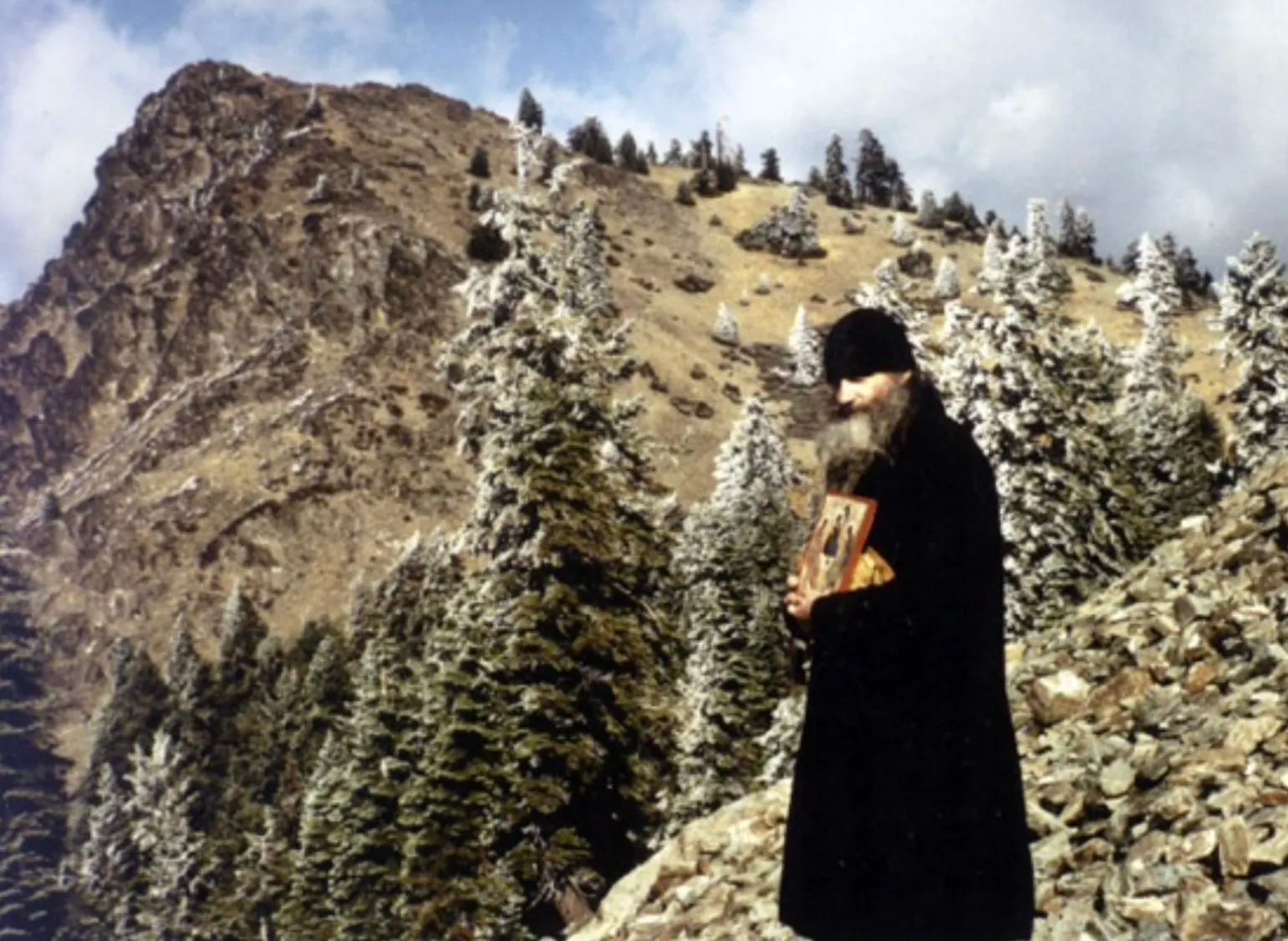
A talk delivered on Sunday, May 12, at St. Nicholas Church in Salem, Mass.
Today is the Sunday of the Samaritan Woman, known in tradition as St. Photini. She was an adulteress. But that doesn’t really matter. We know what Christ did when men tried to single out an adulteress, as though her sin was somehow uniquely awful. Let him who is without sin cast the first stone.
The point is that St. Photini was a sinner, like us. What is sin? It’s like Christ. It promises to bring us peace, consolation—some meaning to our existence. The difference is that sin is a lie; Christ is the Truth. Sin is the stagnant water in the well. Christ is the living water.
St. Photini dragged her water-jug up that mountain. She drew from the well. By the time she got back down the mountain, she’d drunk all that stagnant water. She was thirsty again. So, she turned around and went back up the mountain. Five times this happened. And the fifth time, she meets Christ. And He says to her, “Aren’t you tired? Aren’t you tired of doing the same thing over and over again? Is this working out for you?”
Whoever drinks of this water will thirst again, but whoever drinks of the water that I shall give him will never thirst.
Come unto me, all ye that labour and are heavy laden, and I will give you rest.
This past week, the Holy Synod of the Russian Church Abroad voted to proceed with the glorification of Hieromonk Seraphim Rose.
Fr. Seraphim was born Eugene Dennis Rose in San Diego, 1934. His family were white-bread Methodists. When he was a Cub Scout, his den mother was Gregory Peck’s mom!
Like so many of that generation, Eugene was a lost soul. He tried to find some happiness in life—in alcohol, drugs, other men. He studied world religion at the graduate level. He explored all different kinds of Protestantism, Roman Catholicism, Islam, Buddhism… He learned ancient Chinese so he could read the Tao Te Ching in the original.
Nothing worked. Nothing made him feel whole. He thought about taking his own life. Then one day he found himself at the Holy Virgin Cathedral in San Francisco. He said, “When I entered the Orthodox Church, something in my heart told me, you are home, the search is over!” From that moment on, Eugene became utterly devoted to the Holy Orthodox Faith.
He was received into the Church by chrismation at the age of 28 and became a spiritual son of Archbishop John Maximovich—now St. John the Wonderworker. At 36, he was tonsured a monk, taking the name Seraphim. He founded a monastery, named after St. Herman of Alaska, in the mountains of northern California. At 42, he was ordained a priest.
Fr. Seraphim started a printing press at his monastery. He learned Russian and Slavonic so he could translate service books, the Lives of the Saints, and other life-giving texts for his fellow Americans. He also wrote books of his own, warning his countrymen not to be seduced by the false gods of his day.
Fr. Seraphim traveled the country, from coast to coast, giving talks and preaching the Gospel. He helped thousands of souls into the Orthodox Church over the course of his short life and died in 1982, at the age of 48.
Like St. Photini, he went up to the mountain and found the living water. And like St. Photini, the very first thing he did was run back down again—to tell his neighbors that he had found the Christ.
Fr. Seraphim’s glorification is a blessing to Orthodox Christians all over the world. You’ll find icons of him in Russia, Ukraine, Greece, Georgia, Romania, Albania… But it’s a very special day for us Americans, and especially American converts.
St. Photini said of Christ: Come, see a man, who told me all the things that ever I did… We say the same about St. Seraphim. That restlessness, that hunger we all felt—he felt it first. He found his way home, to the Holy Orthodox Church. And he made it easy for us to follow.
As a new convert, he had some pretty strange views. We all do! We all go through it. Fr. Seraphim called it the “crazy convert” phase. But as he got older, more mature, he outgrew those views—as we hopefully do. And he helped his spiritual children to do the same. And that is what made him a saint.
He came to realize that what Orthodoxy had to offer isn’t a pure, unbroken tradition. It’s not a perfect adherence to the canons. It doesn’t make us better than everyone else. No! Fr. Seraphim said (and this is a quote):
The deepest and most attractive thing about Orthodoxy today is its message of love. The most discouraging thing about today’s world is that it has become so cold and heartless. In the Gospel of St. Matthew our Lord tells us that a leading characteristic of the last times will be that the love of many will grow cold. And the Apostle of love, St. John the Theologian, records our Lord as saying that the chief distinguishing mark of His disciples is the love they have one for another.
(…)
Being filled with the Gospel teaching and trying to live by it, we should have love and compassion for the miserable humanity of our days. Probably never have people been more unhappy than the people of our days, even with all the outward conveniences and gadgets our society provides us with. People are suffering and dying for the lack of God, and we can help give God to them. The love of many has truly grown cold in our days—but let us not be cold. As long as Christ sends us His grace and warms our hearts, we do not need to be cold.
We converts—we all stand on Fr. Seraphim’s shoulders.
The harvest truly is plentiful.
We reap what he sowed.
St. Seraphim of Platina, pray to God for us.