
Argumentum ad Ursos
On the saints and their bears.


“I’m not Orthodox because of some commitment to a set of dogmatic propositions,” writes Loup des Abeilles. “I’m Orthodox because St. Seraphim of Sarov was Orthodox. And I don’t know how to crush that into some kind of disputation with others.”
I was talking to a friend of mine the other day. He’s Catholic. He and his wife have a big, beautiful Catholic family. They belong to a big, beautiful Catholic community. However, he feels increasingly drawn to the Orthodox Church.
He has tried explaining this desire to his family and friends, but they don’t get it. And, hey, fair enough! Not everyone does. But he’s sick of trying. “I’m tired of coming up with reasons and justifications for why I want to become Orthodox,” he says. I shared that quote with him, about St. Seraphim. “That’s it,” he said. “The bear is the main reason I want to be Orthodox.”
The bear’s name is Mischa, by the way. He is, without a doubt, the most effective Orthodox evangelist since Cyril and/or Methodius. There’s just something about St. Seraphim and his bear that makes us say, “Whatever’s going on here, I want in.”
Actually, there are lots of stories about Russian saints with bears: St. Sergius of Radonezh, St. Tryphon of Pechenga, St. Herman of Alaska… These images speak to us in a way that apologetics and academic theology never could. They bypass the mind, with its proofs and arguments, and go straight to the heart.
But why?
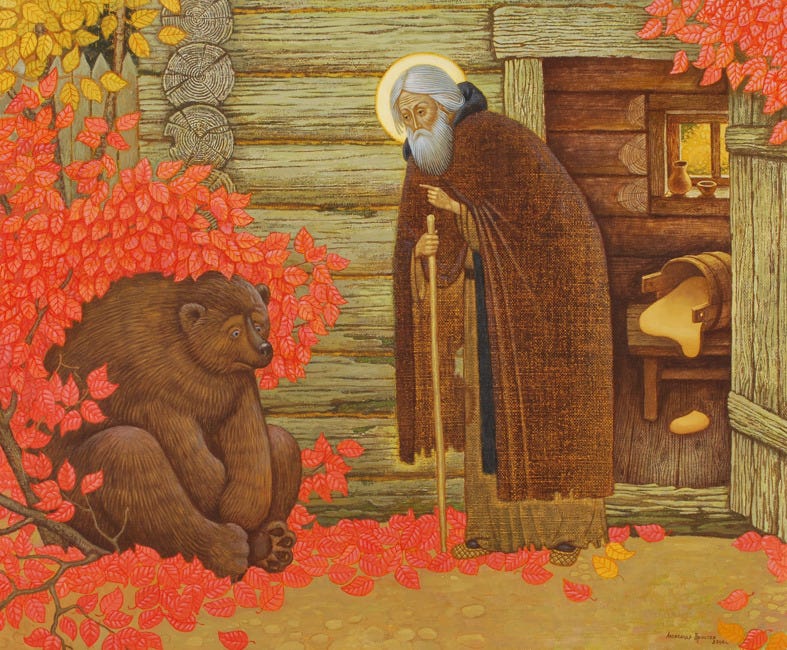
Well, here’s the thing: bears are vicious killing machines. They’re also adorable. The disconnect strikes us as unnatural—unjust, even. On an intuitive level, we know that bears were made for Man’s friendship, and men for Bear’s. This friendship fell apart after the Fall. As Saint Paisios of Mount Athos teaches us,
In Paradise, the animals sensed the fragrance of grace and served Adam. Since the fall, nature has been suffering together with man. Look at the poor hare—it always has a scared look. Its heart is pounding anxiously—rat-a-tat-tat. The poor creature does not sleep at all! How much this tiny, innocent mammal suffers because of our sins! However, when a person returns to the state in which he was before the fall, animals again approach him without fear.
This, in turn, is what St. Paul meant when he told the Romans how all of Creation “groans and labors with birth pangs,” waiting to be “delivered from the bonds of corruption into the glorious liberty of the children of God.”
We get a foretaste of this when we are very young. The world seemed like a very different sort of place to us as little children, didn’t it? We were trusting, because nobody had yet taught us to be suspicious. We assumed that everyone and everything was our friend unless proven otherwise.
As we got older, life gave us plenty of proof. We began to put away our childish fantasy about being friends with animals. After a while, we also put away our childish fantasy about being friends with other people. Somewhere in between, we let go of our friendship with the angels, the saints, even God.
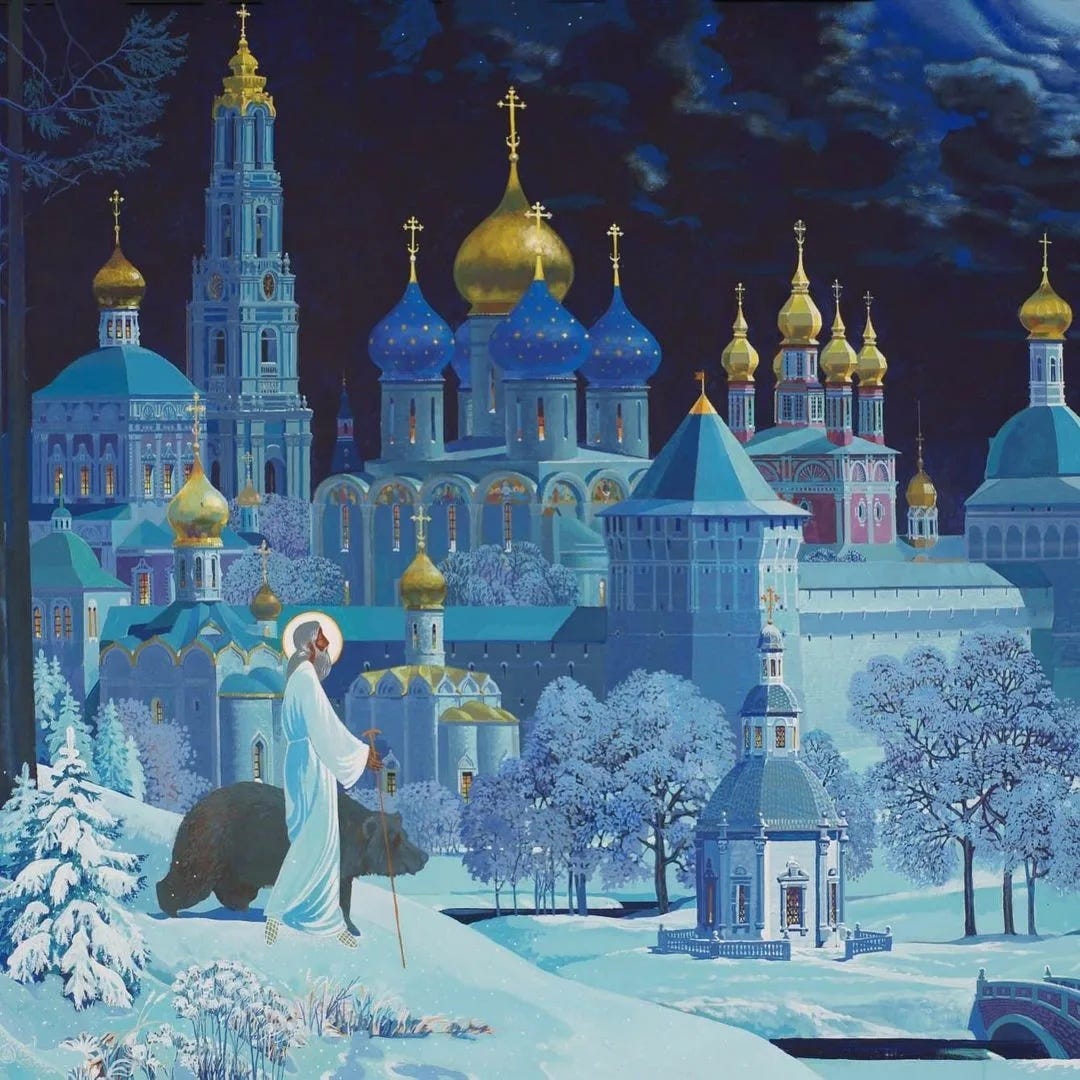
Looking at an icon of St. Seraphim and Mischa is, as the kids would say, a red-pill moment. It wakes us up from this nightmare. The illusion is shattered. We see all the fear and hatred in the world, all the sorrow and suffering and death, for what it really is: a lie. A damned lie.
It doesn’t matter that it’s just an icon, a bit of paint on wood, or just pixels on a screen. It doesn’t matter that the man in the picture died 300 years ago in the Russian wilderness. The heart recognizes him, and it leaps, just as John leapt in the womb of his mother, Elizabeth.
The icon confirms what we already knew, what we have known since we were little children. A better life is possible, if only we follow a better way of living.
David Bentley Hart has argued that the beauty of Jesus Christ is the best (and, in some sense, the only) argument for Christianity. “Christ is a persuasion,” he says, “a form evoking desire”:
What Christian thought offers the world is not a set of “rational” arguments that (suppressing certain of their premises) force assent from others by leaving them, like the interlocutors of Socrates, at a loss for words; rather, it stands before the world principally with the story it tells concerning God and creation, the form of Christ, the loveliness of the practice of Christian charity…
For Christ “embodies a real and imitable practice,” he says, “a style of being that conforms to the beauty of divine love, but that is also a way of worldly godliness.”
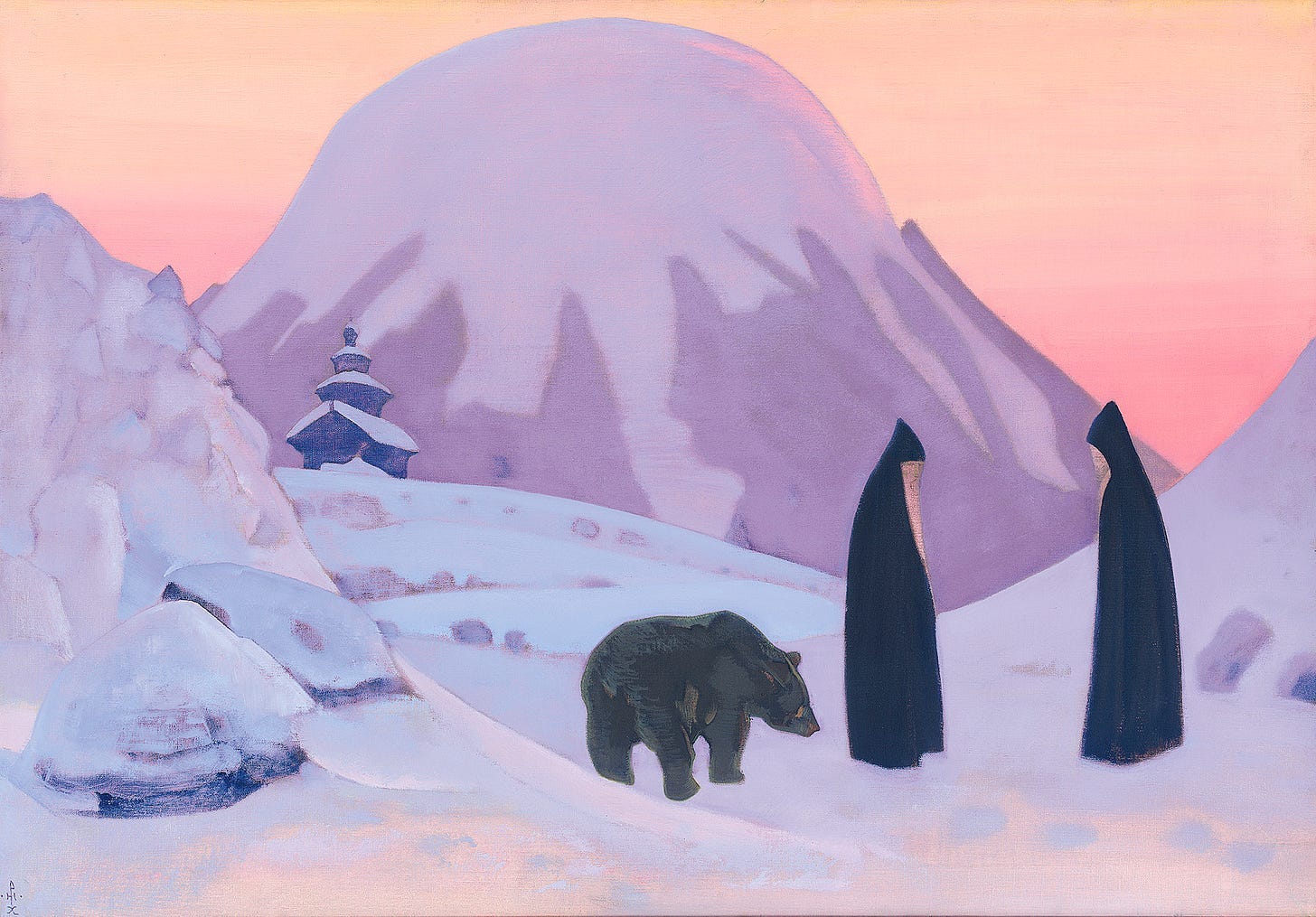
The same could be said for these holy men and their ursine companions. They “evoke desire” because they embody “a style of being that conforms to the beauty of divine love.”
And, in that moment, the very last thing we want to do is fight with anyone. We want to be simple, quiet, gentle, honest, sober, and helpful. We never want an impure thought to cross our minds or a harsh word to pass our lips.
We know that, by following the saints’ example, we can live in harmony with our fellow creatures—and with our Creator. It’s like that line from the psalms:
You have put gladness in my heart,
More than in the season that their grain and wine increased.
I will both lie down in peace, and sleep;
For You alone, O Lord, make me dwell in safety.
The icon is an invitation to live as St. Seraphim lived: in harmony with our fellow creatures—and with our Creator. He “embodies a real and imitable practice, as Hart put it.” Thankfully, Seraphim famously summarized that practice for us in a few short words. “Acquire the spirit of peace,” he said, “and thousands around you will be saved.”
Plus, you get a free bear.
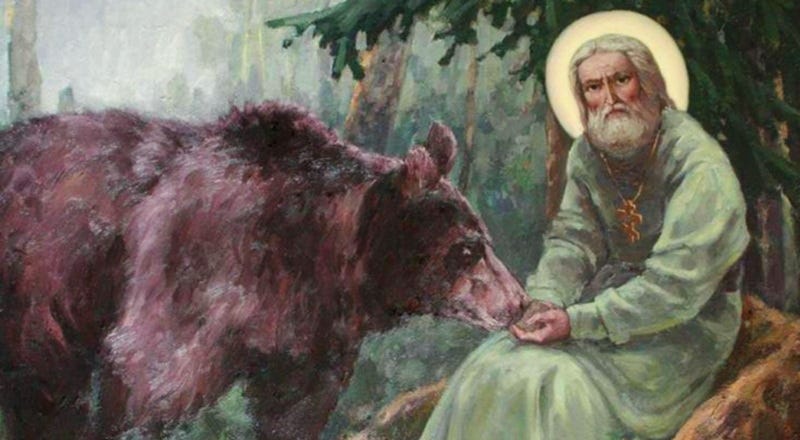
Eastern Orthodox will help save Western Christianity from a slavery to nominalism and propositional epistemology.
I’m glad you’re back and that you brought this essay with you 🙂. p.s. I was at Great Compline last week and was struck when I read “like an owl in a ruined house”. So imagine my delight…